
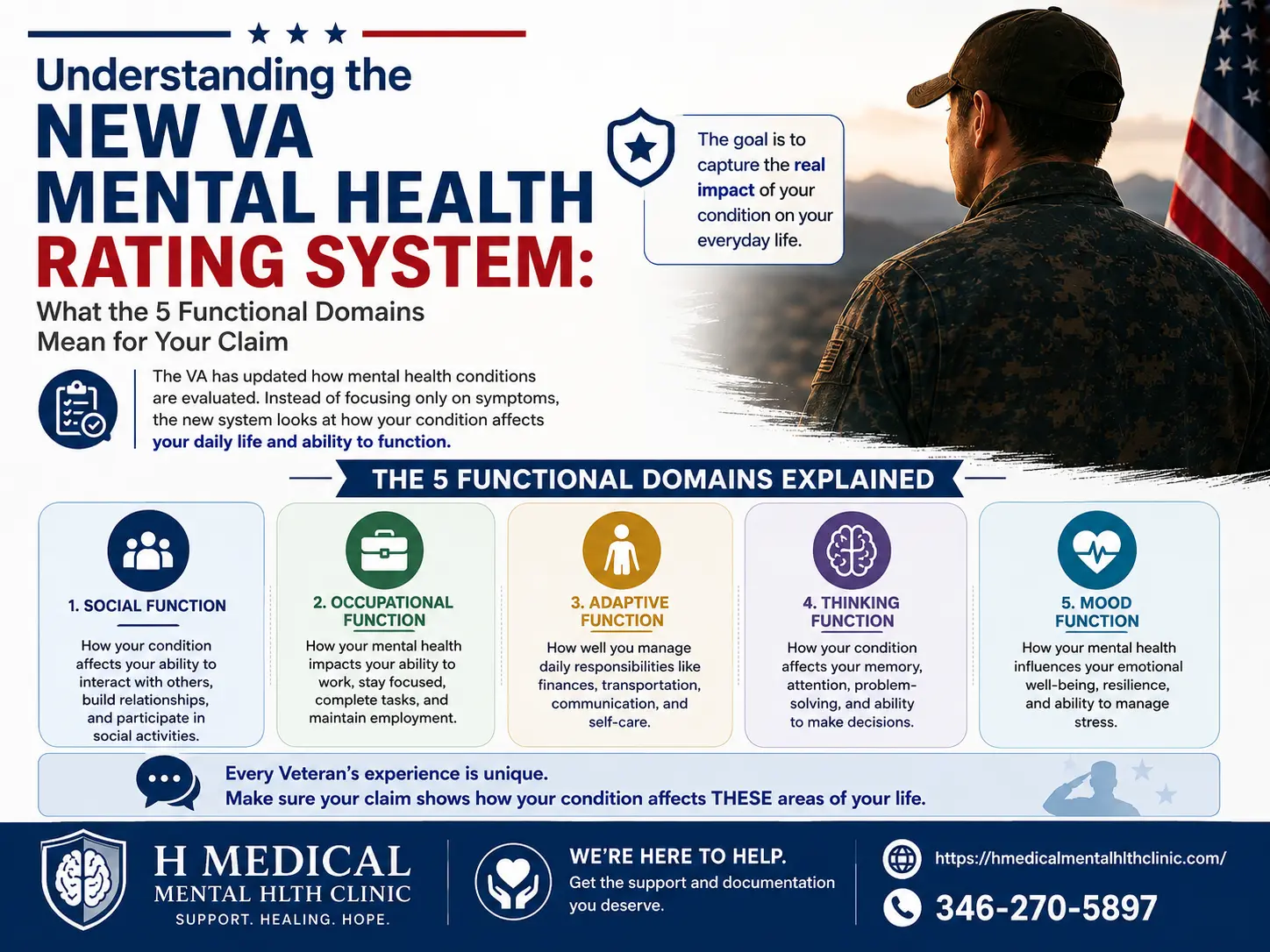
Understanding the New VA Mental Health Rating System: What the 5 Functional Domains Mean for Your Claim
For decades, the Department of Veterans Affairs (VA) has used a traditional paradigm of mostly occupational and social impairment to rate service-connected mental health disorders. Under the legacy criteria set down at 38 CFR 4.130, adjudicators were to consider the effect of symptoms such as anxiety, sadness, or emotional numbing on the veteran’s ability to hold a job or maintain personal relationships.
But the VA advocated a complete reform to bring the rating evaluations into line with modern clinical science. The new grading system is built on Five Functional Domains derived from existing diagnostic methods, such as the World Health Organization Disability Assessment Schedule (WHODAS 2.0). This domain-based approach considers the overall real-world impact of a mental health disorder on day-to-day life, not just on job performance.
If you’re about to file an initial claim, you’re looking for an increase, or you just want to know how these adjustments affect your present benefits, knowing these 5 functional domains is key to managing your claim well.
Key Takeaways
- Domain-Based Evaluation: The VA's updated evaluation framework measures disability across five distinct areas of daily life: Cognition, Interpersonal Relationships, Task Completion, Navigating Environments, and Self-Care.
- Elimination of the 0% Compensable Rating: Under the new rule, the non-compensable 0% mental health rating is eliminated. Any veteran who establishes service connection for a mental health condition will receive a minimum rating of 10%.
- Workplace Distinctions Removed: Veterans no longer need to prove total unemployability or extreme workplace disruption to qualify for higher disability ratings, including 100%.
- Protection for Existing Ratings: Veterans with existing service-connected ratings are grandfathered and protected under 38 CFR § 3.344. Existing ratings will not automatically decrease when the new system takes effect.
- Documentation is Critical: Success under the new framework relies on thorough medical records and Compensation & Pension (C&P) exam notes that clearly capture functioning across all five domains, rather than focusing solely on isolated clinical symptoms.
What’s the New VA Mental Health Rating System?
One of the most significant improvements to VA rating standards in decades is the update to the General Rating Formula for Mental Disorders (38 CFR § 4.130).
Traditionally, VA evaluations of mental health illnesses (e.g., Post-Traumatic Stress Disorder (PTSD), Major Depressive Disorder (MDD), Generalized Anxiety Disorder (GAD), adjustment disorders) have focused primarily on employment impairment and social estrangement. For instance, old regulations called for a veteran to exhibit "total occupational and social impairment" for a 100% rating.
The new system moves the main criteria of assessment to the level of disability in daily life. The VA uses established psychiatric measures, including the WHODAS 2.0 and CAPS-5 (Clinician-Administered PTSD Scale), to measure the extent to which the mental health symptoms interfere with five distinct domains of human functioning. This update acknowledges that many veterans keep working through sheer grit and job concessions, but nonetheless face significant disturbance in their home, emotional, and cognitive life.
What Are the Five Functional Domains in the New System?
To assign an equitable rating, the VA evaluates disability across five core functional areas:
- Cognition
This domain assesses mental processing involved in acquiring, retaining, and applying information. Adjudicators evaluate difficulties with:
- Short-term and long-term memory loss.
- Concentration and sustained attention.
- Speed of processing complex information.
- Judgment, decision-making, and executive planning.
- Interpersonal Interactions and Relationships
This domain measures a veteran's ability to form and maintain healthy, effective relationships in personal, social, and professional settings. Indicators of impairment include:
- Social isolation, detachment, or withdrawal.
- Frequent conflicts with family members, co-workers, or supervisors.
- Inability to build lasting emotional connections or professional rapport.
- Task Completion and Life Activities
This domain examines the ability to initiate, sustain, and complete routine tasks across occupational, educational, and domestic environments. It measures:
- Pacing, reliability, and productivity in fulfilling duties.
- Need for special accommodations or supervisor tolerance to complete basic tasks.
- Difficulty completing routine household chores, financial management, or administrative tasks.
- Navigating Environments
This domain evaluates a veteran's physical and psychological mobility within their surroundings. Evaluators look at:
- Agoraphobia or fear of leaving the home.
- Ability to travel independently using public transit or driving in heavy traffic.
- Discomfort, disorientation, or panic when entering unfamiliar public spaces or crowded environments.
- Self-Care
This domain focuses on basic activities of daily living (ADLs) necessary for personal health and well-being. Assessment includes:
- Personal hygiene, bathing, and grooming routines.
- Dressing appropriately for weather and social settings.
- Nutritional maintenance, regular meal preparation, and medical management.
How Are Severity Levels Scored Across the Five Functional Domains?
Under the proposed rating formula, clinical examiners assign a Severity Score ranging from 0 to 4 for each of the five functional domains based on the frequency and severity of impairment:
Under the proposed rules in 38 CFR § 4.130, doctors do not make subjective judgements but rate each domain on four standardized levels of impairment:
Mild (Level 1): You have symptoms, but they lead to infrequent or mild problems with thinking or socializing. It’s usually not a big deal for you to get along fine with normal effort. Level 2 impairment (Moderate): Obvious effort/adaptation to cope with obvious regular difficulties in completing tasks and living activities or memory.
>Level 3 impairment (Severe): Major and ongoing difficulties in decision-making, movement, or relating to others that significantly restrict daily autonomy.
>Level 4 impairment (Profound): Cannot function in a domain and needs constant monitoring or help with basic self-care and activities of daily living.
The Department of Veterans Affairs said in the Federal Register (87 FR 8498) that more than 1.5 million veterans are now receiving VA disability compensation for mental health conditions. Across the country, the bulk of claims are for PTSD, depression, and anxiety.
How Will the 0% Mental Health Rating Be Affected by the New Rule?
One of the most favorable aspects of the updated rating rule is the complete elimination of the non-compensable 0% mental health rating.
Under the legacy formula, if a veteran established a service-connected mental health diagnosis but exhibited mild or well-controlled symptoms, the VA assigned a 0% rating. While this established service connection, it provided $0.00 in monthly financial compensation.
Key Changes to the 0% Rating:
- 10% Minimum Floor: Under the new system, establishing service connection for any mental health condition automatically guarantees a minimum compensable rating of 10%.
- Recognition of Treatment Impact: The VA recognizes that even "mild" mental health conditions require ongoing energy, management, or coping strategies that warrant monetary compensation.
- Automatic Upgrade Opportunities: Once finalized, veterans currently holding a 0% non-compensable rating can apply to upgrade their rating to 10% or higher based on functional domain impairment.
How Will Existing Ratings Be Protected Under 38 CFR § 3.344?
Many veterans are concerned that a new rating schedule could cause unanticipated decreases in their present VA disability compensation. 38 CFR Section 3.344 offers extensive protections under federal law against arbitrary rating lowering.
If you were rated under the old schedule at your present rating, the VA can’t reduce your percentage only because the rating formula changed. Before it may propose a reduction, the VA has to verify that your condition has improved throughout the course of your whole medical history. This is under 38 CFR § 3.344.
In addition, if the new approach results in a better rating for your illness, you can file a claim for an increase. Submitting updated medical records, private treatment records, lay statements, and buddy statements help prove your genuine level of functional impairment under the new domain criteria.
Why Are Thorough C&P Exams and Medical Records Critical?
Because the new rating system centers on functional domain scores rather than diagnostic labels alone, your medical evidence must clearly reflect how your symptoms impact daily living.
Essential Evidence for Functional Domain Claims:
- Targeted C&P Disability Benefits Questionnaires (DBQs): Examiners must complete mental health DBQs that thoroughly assess all five functional domains. Ensuring your examiner asks about memory, self-care, and environmental comfort—not just work performance—is vital.
- Detailed Lay Statements (Buddy Statements): Statements from spouses, family members, roommates, or close co-workers provide clear evidence of functional impairment in domains like Self-Care or Navigating Environments that a doctor might not observe during a 30-minute exam.
- Therapy & Psychiatry Notes: Continuous treatment records from private or VA providers that document daily challenges (e.g., forgetting medications, avoiding public stores, social withdrawal) serve as objective support for Level 2, 3, or 4 severity scores.
What Are Common Questions Veterans Ask About the New Rating System?
When will the new VA mental health rating system take effect?
The VA proposed these regulatory updates in the Federal Register. The VA is still finalizing the rule. Until then, legacy criteria under 38 CFR § 4.130 remain in effect. Veterans should monitor official VA announcements and prepare their medical evidence early.
Will the new system automatically change my existing PTSD or depression rating?
No. Your current service-connected rating will not automatically change. Existing ratings are protected under grandfathering rules and 38 CFR § 3.344. Your rating will only be re-evaluated under the new criteria if you choose to file a claim for an increase or request an explicit review.
Can I file a claim for secondary mental health conditions under the new system?
Yes. You can continue to file claims for secondary mental health conditions (such as depression or anxiety secondary to tinnitus). Once the new rule is finalized, secondary mental health claims will be evaluated using the 5 functional domains.