
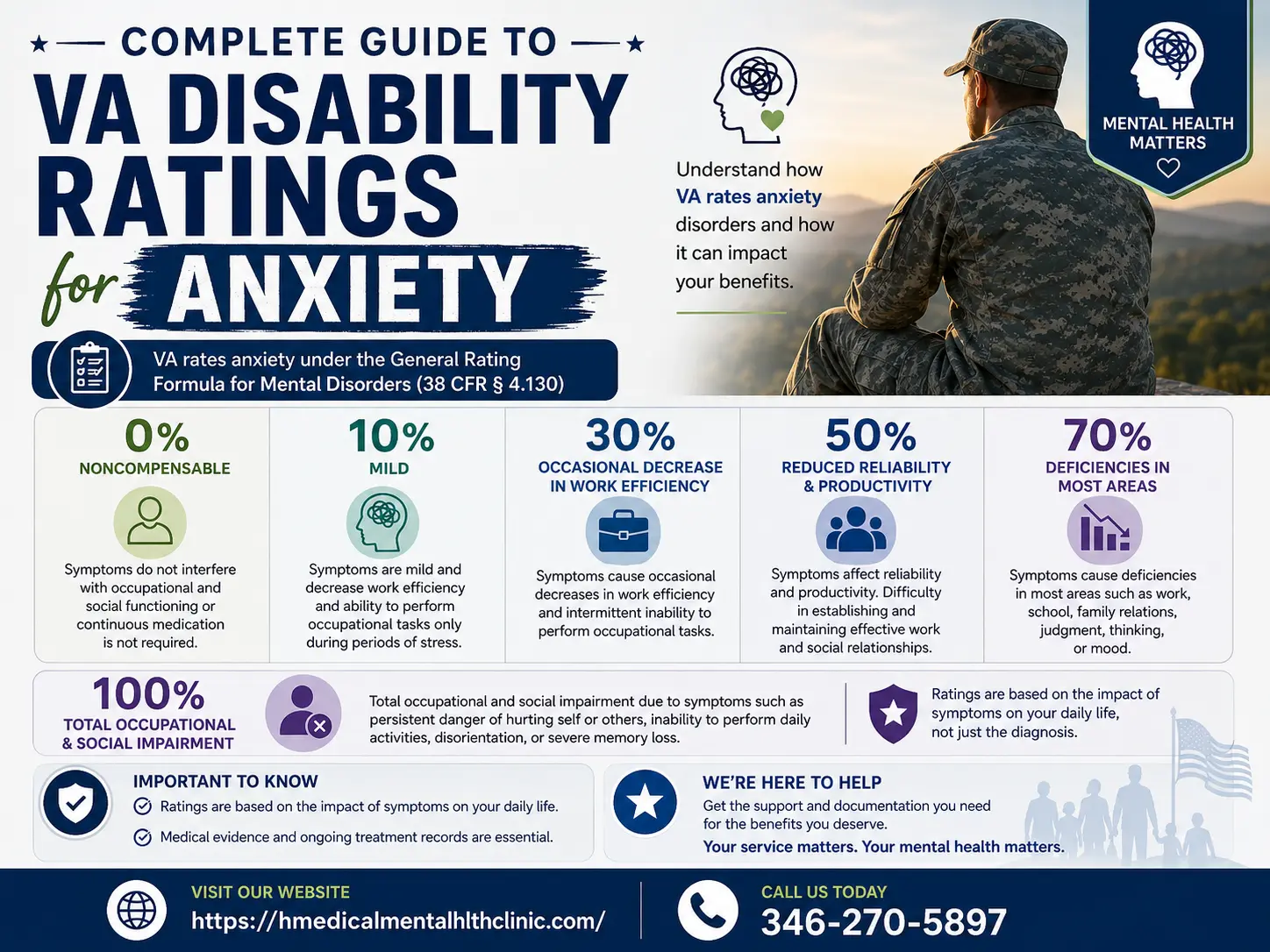
Complete Guide to VA Disability Ratings for Anxiety
Anxiety is one of the most common service-connected ailments veterans claim. However, a lot of veterans are getting a lower rating than they deserve simply because they don’t know how the Department of Veterans Affairs (VA) rates mental health claims.
The VA evaluates anxiety disorders, such as Generalized Anxiety Disorder (GAD), panic disorder, and social anxiety, on a scale from 0% to 100% depending on the severity of your symptoms and the degree to which they interfere with your ability to function in work and personal relationships. The secret to getting the most benefits, whether you are filing an initial claim, requesting an increase, or appealing a decision, is knowing the particular symptom criteria and evidence required to qualify for each rating level.
How the VA Rates Anxiety Disorders
The VA rates anxiety at 0%, 10%, 30%, 50%, 70%, or 100%. For physical limitations, they mostly rate you based on how much range of motion you have. For mental health ratings, they rate you based on how much your symptoms interfere with your ability to work and maintain connections with people.
Deep Dive: What Symptoms Qualify for Each Rating Tier?
You do not need to experience every symptom listed in a rating tier to get that percentage. The VA looks at your disability as a whole.
10% Rating
- Mild symptoms of anxiety in times of high stress.
- Symptoms are controlled with current medication at a level that does not usually interfere with work performance.
30% Rating
- Occasional unprovoked panic attacks (1-2/week or fewer).
- Less severe chronic anxiety and sleep problems (insomnia, nightmares).
- Mild fatigue or depressed mood impacting everyday activities.
- Frequently lose focus or productivity at work.
50% Rating
- Recurring panic attacks (more than once a week).
- Marked decline in work productivity or reliability.
- Difficulty with complex instructions or multi-step tasks.
- Impaired short- or long-term memory.
- Difficulty maintaining healthy social or familial relationships.
70% Rating
- Near-continuous panic attacks, intense hypervigilance, or severe paranoia.
- Inability to establish or maintain meaningful relationships (frequent social isolation).
- Neglect of personal hygiene and self-care.
- Suicidal ideation (thoughts without active intent).
- Frequent inability to perform work-related duties or handle workplace authority.
100% Rating
- Persistent danger of hurting self or others.
- Gross impairment in thought processes or communication.
- Inability to perform basic activities of daily living (bathing, dressing, eating) without assistance.
- Total disorientation to time, place, or person.
The 3 Elements Needed for Service Connection
To receive a service-connected rating for anxiety, your claim must contain three core elements:
- Current Diagnosis: A formal diagnosis of the best anxiety treatment from a licensed medical professional (psychiatrist, psychologist, or physician).
- In-Service Event or Stressor: Documented evidence of an event, injury, trauma, or prolonged stressful condition during active-duty service that triggered or aggravated your condition.
- Medical Nexus: An expert medical opinion linking your current diagnosed anxiety directly to your military service (often provided in a formal Nexus Letter).
Secondary Service Connection
If your anxiety is caused or worsened by an existing service-connected physical condition—such as chronic pain, tinnitus, or a traumatic brain injury (TBI)—you can file for anxiety as a secondary service connection.
TDIU: How to Get Paid at the 100% Rate for Severe Anxiety
If your service-connected anxiety prevents you from maintaining substantially gainful employment, but your scheduler rating is below 100% (e.g., rated at 70%), you may qualify for Total Disability Based on Individual Unemployability (TDIU).
TDIU provides the full monetary compensation of a 100% rating. To qualify schedulable:
- You have a single rating of at least 60% (such as a 70% rating for anxiety), OR
- You have a combined rating of at least 70%, with at least one individual rating of 40% or higher.
Tips for Your Compensation & Pension (C&P) Exam
Your C&P exam for anxiety is often the single most influential factor in your rating determination.
- Describe Your Worst Days: Do not downplay your symptoms or report how you feel on a "good day." Frame your answers around your average or worst days.
- Focus on Function, Not Just Feelings: Explain how your symptoms directly affect your job performance, attendance, marriage, and friendships.
- Bring a Symptom Log: Track panic attacks, sleep disruptions, missed workdays, and social avoidance in a journal for 30–60 days prior to your exam.
- Review the DBQ: Familiarize yourself with the Disability Benefits Questionnaire (DBQ) for Mental Health Disorders before the appointment so you know what topics the examiner will evaluate.
FAQ:
1. Can I get separate ratings for both anxiety and PTSD or depression?
No. Under the VA’s anti-pyramiding rule (38 CFR § 4.14), you cannot receive multiple ratings for overlapping mental health symptoms. If you are diagnosed with anxiety and another condition (like PTSD or major depression), the VA combines your symptoms into a single mental health rating based on overall functional impairment.
2. What is the most common VA rating assigned for anxiety?
30% and 50% are the most common initial ratings. A 30% rating generally applies if you can work but have intermittent sleep disruptions, occasional panic attacks, or mild concentration issues. A 50% rating applies when anxiety noticeably reduces your workplace productivity and reliability.
3. Does taking medication reduce my disability rating?
Not necessarily. Needing continuous medication to maintain stability is actually a key requirement for maintaining at least a 10% rating. If you still experience anxiety symptoms, panic attacks, or medication side effects (like fatigue or brain fog) while on medication, you can still qualify for 30%, 50%, or higher.
4. How does a secondary service connection for anxiety work?
If your anxiety was directly caused or made worse by an existing service-connected physical issue—such as chronic pain, tinnitus, or a traumatic brain injury (TBI)—you can file for anxiety as a secondary condition. You must provide a medical nexus letter showing a direct link between the physical condition and your anxiety.
5. Can the VA lower my anxiety rating once it is approved?
Yes, but only under specific legal rules. The VA can propose a reduction if medical evidence shows sustained, long-term improvement. However:
- 5-Year Rule: Ratings active for 5+ years cannot be reduced based on a single re-exam.
- 20-Year Rule: Ratings active for 20+ years are fully protected.
- Permanent & Total (P&T): Exempt from routine re-examinations.
6. What if my anxiety makes it impossible to hold down a job?
If your anxiety keeps you from maintaining substantially gainful employment, but your rating is less than 100% (e.g., 70%), you can apply for Total Disability Based on Individual Unemployability (TDIU). If approved, TDIU pays at the 100% disability rate.