
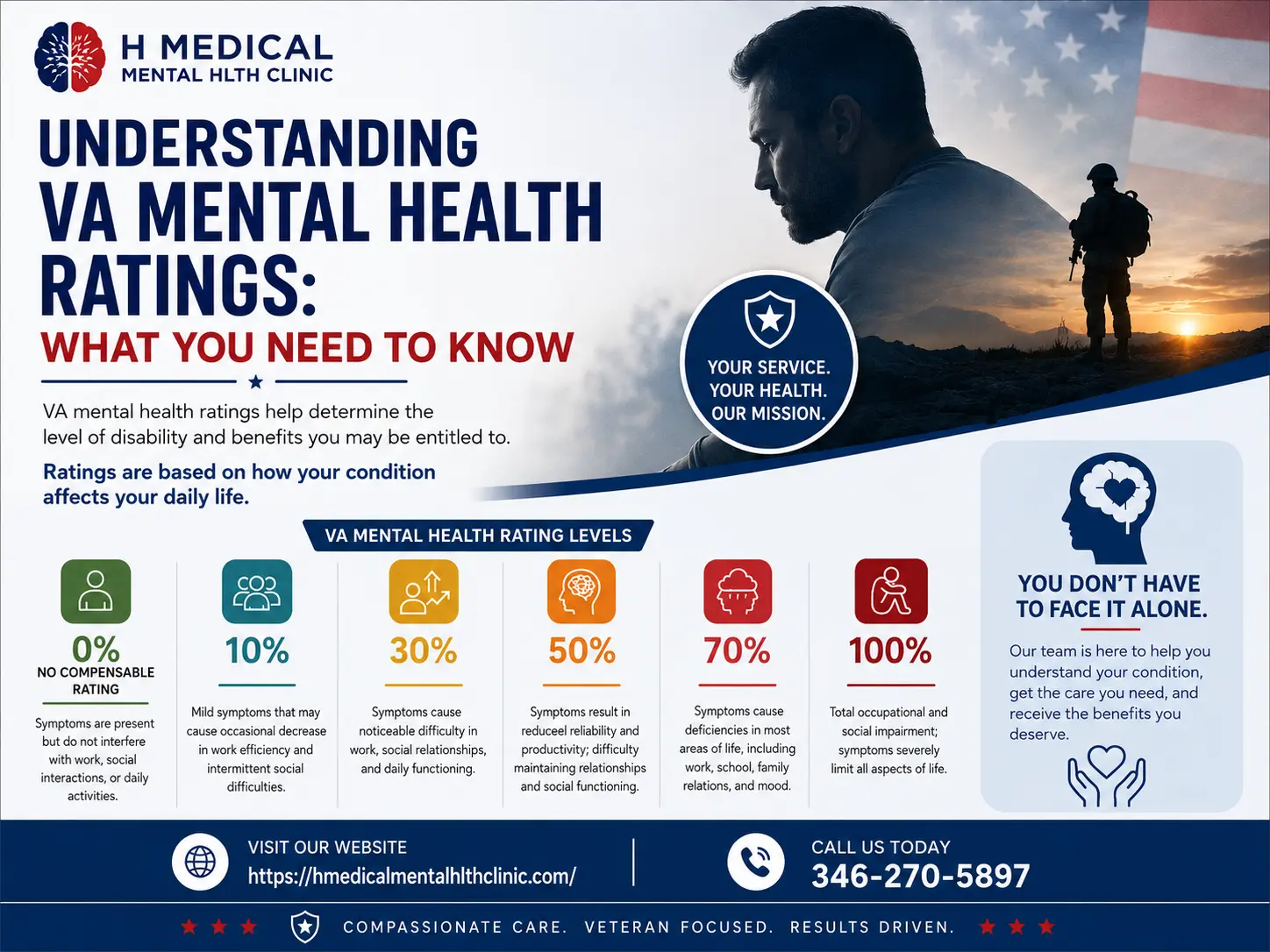
Understanding VA Mental Health Ratings: What You Need to Know
Navigating the Department of Veterans Affairs (VA) disability system can feel overwhelming, especially when seeking compensation for mental health conditions. Understanding how the VA evaluates, rates, and awards benefits for mental health disorders is the first step toward securing the benefits and support you have earned through your service.
Key Takeaways
- The VA Uses One Main Scale: Most mental health conditions are evaluated under a single rating schedule (38 CFR § 4.130) based on social and occupational impairment rather than the specific diagnosis name.
- Ratings Range from 0% to 100%: The standard rating tiers are 0%, 10%, 30%, 50%, 70%, and 100%.
- Pyramiding Is Prohibited: You generally cannot receive separate, additive ratings for multiple mental health conditions (e.g., PTSD and depression combined); the VA assigns one rating for your overall mental health symptoms.
- Evidence Is Everything: Service connection relies on three pillars: a current diagnosis, an in-service incident/event, and a medical link (nexus) connecting the two.
- TDIU Offers an Alternative: If your mental health symptoms prevent you from maintaining substantially gainful employment but your rating is under 100%, you may qualify for Total Disability based on Individual Unemployability (TDIU).
What Are VA Mental Health Ratings?
VA mental health ratings are percentage-based evaluations awarded by the VA to measure the severity of a veteran's service-connected mental health condition. These percentage ratings directly determine the amount of monthly tax-free disability compensation a veteran receives, as well as eligibility for healthcare enrollment tiers and additional benefits.
Rather than rating a condition based on its clinical title alone, the VA assigns ratings based on how severely the mental health disorder impairs your ability to function in everyday personal, social, and professional environments.
Why Is Understanding VA Mental Health Rating Criteria Crucial?
Understanding the VA's rating criteria allows you to present your claim clearly, accurately, and effectively. Many claims are delayed, underrated, or denied simply because veterans do not know how to articulate their symptoms using the specific legal and medical terminology the VA looks for.
When you know the criteria, you can:
- Ensure your medical records and personal statements accurately document your worst symptoms.
- Speak effectively and honestly during Compensation & Pension (C&P) exams.
- Recognize when a decision is underrated so you can appeal effectively.
What Is the General Rating Formula for Mental Disorders?
The VA uses the General Rating Formula for Mental Disorders to evaluate almost all psychiatric conditions. Under this framework, the VA does not measure the severity of a diagnosis by symptom counts alone; instead, it looks at how those symptoms translate into occupational and social impairment.
Ratings follow a standardized scale: 0%, 10%, 30%, 50%, 70%, and 100%.
Because of the VA rule against "pyramiding" (rating the same symptom twice under different diagnoses), a veteran diagnosed with PTSD, generalized anxiety disorder, and major depressive disorder will typically receive a single combined rating for all mental health conditions based on their total combined impact on functioning.
Which Common Conditions Fall Under VA Mental Health Ratings?
The General Rating Formula applies to a broad range of mental health conditions recognized in the DSM-5 (Diagnostic and Statistical Manual of Mental Disorders). Common conditions include:
- Post-Traumatic Stress Disorder (PTSD) (including Military Sexual Trauma / MST)
- Major Depressive Disorder (MDD) and Persistent Depressive Disorder (Dysthymia)
- Generalized Anxiety Disorder (GAD), panic disorder, and Specific Phobias
- Adjustment Disorders
- Bipolar Disorder and Cyclothymic Disorder
- Somatic Symptom Disorder
- Schizophrenia and Other Psychotic Disorders
(Note: Eating disorders are evaluated under a separate rating scale, 38 CFR § 4.134).
What Is the Specific 38 CFR 4.130 Rating Criteria?
The legal standard governing mental health claims is 38 CFR § 4.130 (Diagnostic Code 9440). The rating tiers break down as follows:
The 100% VA Rating Criteria
- Level of Impairment: Total occupational and social impairment.
- Key Symptoms & Indicators: Gross impairment in thought process or communication; persistent delusions or hallucinations; inappropriate behavior; persistent danger of hurting self or others; inability to perform activities of daily living (ADLs) independently; complete disorientation as to time, place, or person; memory loss for own name or family.
The 70% VA Rating Criteria
- Level of Impairment: Occupational and social impairment with deficiencies in most areas (such as work, school, family relations, judgment, thinking, or mood).
- Key Symptoms & Indicators: Suicidal ideation; obsessional rituals which interfere with routine activities; speech markedly affected; near-continuous panic or depression affecting the ability to function independently, effectively, and appropriately; impaired impulse control (such as unprovoked irritability or violence); spatial disorientation; neglect of personal appearance and hygiene; inability to establish and maintain effective relationships.
The 50% Rating Criteria
- Level of Impairment: Occupational and social impairment with reduced reliability and productivity.
- Key Symptoms & Indicators: Flattened affect; circumstantial, circumlocutory, or stereotyped speech; panic attacks occurring more than once a week; difficulty in understanding complex commands; impairment of short- and long-term memory; impaired judgment; impaired abstract thinking; disturbances of motivation and mood; difficulty in establishing and maintaining effective work and social relationships.
The 30% Rating Criteria
- Level of Impairment: Occupational and social impairment with occasional decrease in work efficiency and intermittent periods of inability to perform occupational tasks.
- Key Symptoms & Indicators: Depressed mood, anxiety, suspiciousness, panic attacks (weekly or less frequent), chronic sleep impairment, mild memory loss (forgetting names, directions, or recent events).
(Note: A 10% rating reflects occupational and social impairment due to mild or transient symptoms, while a 0% rating acknowledges a formal diagnosis with symptoms controlled by continuous medication).
What Is the Process of VA Mental Health Evaluations?
The evaluation process begins when you file a formal claim (VA Form 21-526EZ).
- Initial Review: The VA reviews your submitted military records, medical history, and supporting statements.
- Scheduling the C&P Exam: If there is sufficient evidence of an in-service incident and a current diagnosis, the VA requests a Compensation & Pension exam with a licensed mental health professional (psychologist or psychiatrist).
- Rating Decision: A VA Rating Veteran Service Representative (RVSR) reviews the examiner's report alongside your medical evidence to assign a rating percentage and effective date.
What Should You Expect During a Mental Health C&P Exam?
A C&P exam is a medical-legal evaluation, not a therapy session. The examiner's job is to evaluate the severity of your symptoms and assess whether your condition is linked to your military service.
- Format: The exam typically lasts 30 to 90 minutes and can be conducted in person or via telehealth.
- Questions Asked: The examiner will review the Disability Benefits Questionnaire (DBQ) for mental health. They will ask about your military history, symptoms, employment impact, personal relationships, and pre-service background.
- Key Tip: Be open and transparent. Describe your worst days, not your best days. Do not minimize your struggles out of pride or habit.
How Are Mental Health Ratings Determined?
When assigning a rating percentage, VA rating officials look at the complete evidentiary picture:
- The DBQ from the C&P Examiner: Particular attention is paid to the section where the clinician checks the box indicating your overall level of social and occupational impairment.
- Medical Treatment Records: Continuity of care, clinical progress notes, prescriptions, and hospitalization records from the VA or private providers.
- Lay Statements: Personal statements (VA Form 21-4138) and "Buddy Letters" from family, friends, or co-workers detailing how your behavior and daily functioning have changed over time.
The rating official maps these findings against 38 CFR § 4.130. You do not need to meet every symptom listed in a specific rating tier to receive that rating; the list of symptoms in 38 CFR § 4.130 is illustrative, not exhaustive.
How Do You Go About Claiming VA Mental Health Disability?
To establish a direct service connection for a mental health claim, you must satisfy three legal elements:
- A Current Diagnosis: A formal diagnosis of a mental health condition from a qualified medical professional.
- An In-Service Event or Stressor: Documented proof of an event, injury, trauma, or stressor that occurred during military service.
- A Medical Nexus: A professional medical opinion linking your current diagnosed mental health condition directly to the in-service event or overall service experience.
You can submit your claim online at VA.gov, by mail, or with the assistance of an accredited Veteran Service Officer (VSO).
What Documentation Is Required for Claims?
To give your claim the best chance of approval, gather the following documentation:
- Service Treatment Records (STRs) or military personnel records showing treatment, incident reports, performance drops, or disciplinary actions.
- Private and VA Medical Records showing current treatment, diagnostic evaluations, and therapy notes.
- Personal Statement (VA Form 21-4138): A detailed account explaining the onset of your symptoms and how they impact your day-to-day life and employment.
- Buddy Letters (VA Form 21-10210): Statements from fellow service members, spouses, family members, or supervisors describing observable changes in your mood, behavior, and social interactions.
- Nexus Letter: An independent medical opinion written by a qualified specialist connecting your current diagnosis to service (especially critical for secondary or contested claims).
What Are the Best Tips for a Successful Claim Submission?
- File an Intent to File First: Submitting an Intent to File (VA Form 21-0966) establishes your effective date immediately, giving you up to one year to gather evidence while preserving back-pay eligibility.
- Document Your Worst Days: Focus on how your symptoms affect you during severe flare-ups rather than on days when you feel stable.
- Establish a Consistent Treatment History: Ongoing therapy or medication management provides clear, continuous evidence of your condition's severity over time.
- Work with Accredited Representation: Work with an accredited VSO, claims agent, or disability attorney to ensure your file is complete and properly formatted before submission.
Frequently Asked Questions About VA Mental Health Ratings
Can I get separate ratings for PTSD and panic disorder?
Generally, no. The VA regulations prohibit "pyramiding"—assigning multiple ratings for the same symptoms. Because PTSD, panic disorder, and depression share overlapping symptoms (such as sleep issues or anxiety), the VA combines them into a single mental health rating based on overall impairment.
What is TDIU and how does it help?
Total Disability Based on Individual Unemployability (TDIU) allows veterans to receive tax-free disability compensation at the 100% rate even if their service-connected disability rating is below 100% (e.g., a 70% mental health rating). To qualify, you must show that your service-connected conditions prevent you from securing or maintaining substantially gainful employment.
Can I file an MST claim without an official police report?
Yes. Visits to civilian healthcare providers, rape crisis centers, or counselors. The VA accepts "markers" or circumstantial evidence to corroborate the event, such as requests for unit transfer, sudden changes in work performance, substance abuse, severe changes in personal relationships, or statements from family and friends.
Does a private medical evaluation guarantee an approval?
While an evaluation or Nexus Letter from a private psychologist or psychiatrist carries significant evidentiary weight, it does not automatically guarantee approval. The VA considers the entire record, including C&P exam findings and treatment continuity.
What should I do if my claim is denied?
If your claim is denied or underrated, you have three primary appeal pathways under the VA Appeals Modernization Act (AMA):
- Higher-Level Review (HLR): A senior reviewer re-evaluates the existing evidence without adding new records.
- Supplemental Claim: You submit new and relevant evidence to support your claim.
- Board of Veterans' Appeals (BVA): You appeal directly to a Veterans Law Judge at the Board in Washington, D.C.
Conclusion: Navigating VA Mental Health Ratings with Confidence
Securing the VA mental health rating you deserve requires patience, clear evidence, and an understanding of the 38 CFR § 4.130 criteria. By framing your evidence around social and occupational impairment, staying consistent with medical care, and utilizing accredited support, you can navigate the claims process with confidence and secure the compensation and care you have earned.