
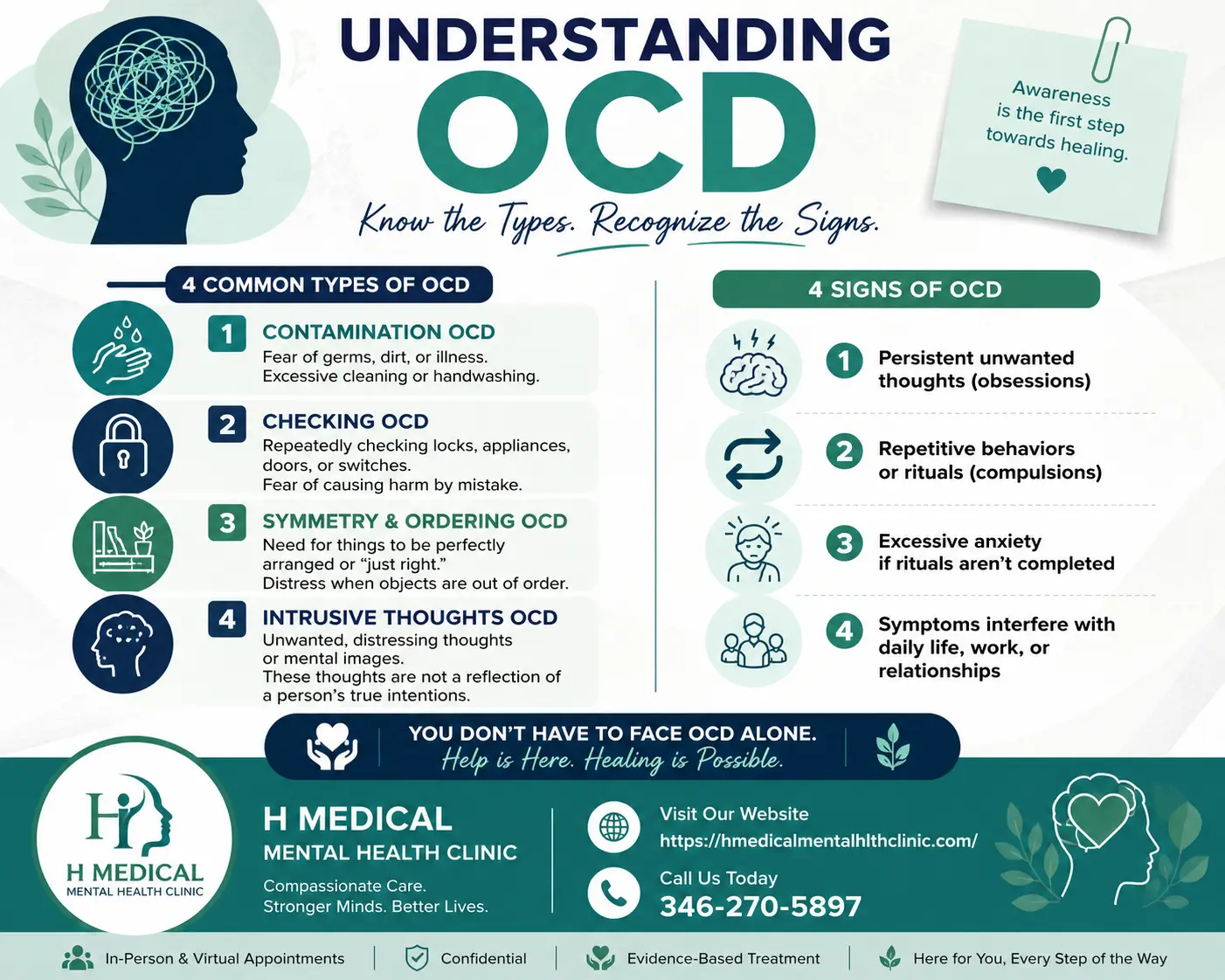
This guide will help you understand the core of OCD, discuss in detail the four most common types of OCD, clarify the difference between clinical symptoms and regular habits, and give you the first step toward healing with Best Mental Hospital in Houston.
The two core symptoms of the condition are OBSESSIONS and COMPULSIONS.
It's easier to grasp the operation of OCD Symptoms with each of its forms by examining its two main components, obsessions and compulsions. These two combine to form a vicious circle that can lead a person to remain in anxiety.
Obsessions are persistent, intrusive, and unwanted thoughts, images, or urges that invade the person's mind repeatedly and without invitation. Obsessions are not typical concerns about money or the amount of work on one's plate, but are worrying and uncontrollable. They often involve disturbing topics (such as a horrid fear of contamination, the inability to stop worrying whether a safety task was performed, graphic unwanted thoughts of harm, or an overpowering desire for perfect symmetry). These intrusive thoughts often clash with their own ethical and moral values, leading to feelings of anxiety, shame, and fear.
Due to that overwhelming anxiety, the brain feels compelled to act on its compulsions. Compulsions are repetitive behaviors or mental routines that are performed to stop the threat, extinguish the panic, or to avoid the feared disaster. They can be obvious behaviors, such as washing hands too much, checking locks over and over, arranging things over and over, or they can be internal behaviors, such as silently repeating prayers, counting numbers in patterns, or seeking constant reassurance from loved ones.
This leads to the classic OCD Cycle of an intrusive obsession causing extreme anxiety, which leads to a compulsive behavior. The ritual may temporarily alleviate feelings for a short period of time, but it also helps the brain to develop a false sense of reality in the belief that the obsession was genuine. The intrusive thought comes back, and soon and again, maybe even stronger, the cycle begins again.
What are the 4 types of OCD:
OCD can present with virtually any fear or theme, but clinical research has identified four main types of symptoms. An individual's primary problem can be a single type, or symptoms can change from one type to another over time.
1. Contamination OCD
Contamination OCD is more than just the aversion to dirt or germs. People with this subtype feel an intense and overwhelming fear of biological viruses, toxic chemicals, house dust, or disgusting ideas of "dirty or soiled.
The obsessive fear is usually over catching some serious diseases, introducing harmful germs into the house, or infecting loved ones. In turn, people carry out intense compulsive rituals like scrubbing their hands with hard soap until they are red and raw, showering several times a day, or cleaning their personal possessions continuously. Many also develop avoidance behaviors such as avoiding touching door handles, eating in public areas, or shaking hands.
Signs to watch for: physical signs such as dry, cracked, and bleeding hands and arms, and time spent inside instead of outside due to length of decontamination rituals. Social isolation from crowds or family is also very prevalent.
2. Symmetry, Ordering, “Just Right” OCD
This subtype is characterized by an inner need for balance, exactness, and precision. Individuals with Symmetry and Ordering OCD have strong feelings of unease and stress when things are not lined up, straight, or complete.
In the intrusive thought subtype, the intrusive thought is typically a sense of something being “off” or “wrong.” In some cases, it is a form of magical thinking, the absolute conviction that if objects are not in an even balance, some member of the family will get in trouble. To relieve this distress, they repeat some actions such as rearranging things on desks or shelves, performing the same physical action on both the left and right side of the body, counting steps through a numeric sequence, or repeating actions of daily living until they feel “just right.”
Signs to look for: Excessive time is spent arranging toys or objects around the home or office, or visible anxiety is seen when objects are moved, or simple tasks like getting dressed and writing take a long time to complete because everything has to feel "balanced.
3. Checking OCD
Checking OCD arises from a great deal of uncertainty and fear of being responsible for a serious accident because of carelessness or lack of focus.
The central focus is on the nagging insecurities: the stove was turned on, the front door was unlocked, perhaps there's been a fatal error in an e-mail message. The person is afraid that doing nothing will cause a disaster, and he or she may check – and recheck – the locks on doors, knobs on appliances, light switches, or written notes dozens of times before he or she feels safe. Some may even drive down a street several times just to make sure they didn't hit someone by accident.
Signs to look for: Behavioral red flags are when you're consistently late to work because you have to check your phone before leaving the house. Your body may also experience some physical signs of pulling and turning the same locks, handles, or appliance knobs over and over, such as wear and tear. The individual is usually depressed and jittery.
4. Intrusive Thoughts OCD (Taboo, Harm, and Scrupulosity OCD)
Intrusive Thoughts OCD centers on disturbing, deeply unwanted thoughts, urges, or mental images surrounding forbidden or taboo topics. Although historically referred to as "Pure O," compulsions do exist in this subtype—they are simply internal mental rituals rather than outward physical acts.
This subtype manifests across several themes. Harm OCD involves graphic mental images of accidentally or intentionally hurting oneself or others. Scrupulosity involves constant guilt over whether one has sinned or violated moral codes. Relationship OCD triggers agonizing doubts about whether one truly loves their partner, while Existential OCD leads to spiraling dread over the nature of reality and existence. To cope with these distressing thoughts, individuals perform mental compulsions—such as mentally reviewing past memories to prove innocence, silently repeating "safe" words to replace bad thoughts, or constantly asking loved ones for moral reassurance.
How to spot the signs: Because the compulsions happen internally, the person may appear calm on the outside while experiencing severe distress internally. Look for subtle signs like sudden withdrawal, avoidance of sharp objects or specific situations, and repetitive asking for validation about their character or feelings.
How to Tell Normal Habits Apart From OCD
It is completely normal to double-check a door lock on occasion, organize a bookshelf, or feel anxious about germs during flu season. So where is the line between standard human behavior and clinical OCD?
According to guidelines from the National Institute of Mental Health Clinic, clinical OCD is defined by key clear distinctions:
- Control: Standard habits can be easily set aside, whereas OCD compulsions feel uncontrollable, even when you know they are excessive.
- Time Spent: Everyday routines take a few seconds or minutes, while OCD obsessions and rituals consume one hour or more every single day.
- Emotion: Normal hobbies or organizing bring satisfaction and peace, but OCD compulsions provide no pleasure—only temporary relief from intense anxiety.
- Daily Impact: Clinical OCD causes significant disruption to your personal relationships, career performance, academic goals, and overall quality of life.
Taking the Next Step Toward Recovery
If these signs resonate with you or someone you care about, remember that OCD is a manageable and highly treatable condition. It is not a character flaw or a personal weakness, and you do not have to carry the weight of intrusive thoughts alone.
Effective treatments like Cognitive Behavioral Therapy (CBT)—specifically Exposure and Response Prevention (ERP)—help retrain the brain to manage anxiety without relying on compulsive rituals. Combined with professional psychiatric care and personalized medication management when appropriate, most individuals experience significant relief and reclaim control over their lives.
At H Medical Mental Health Clinic, our compassionate team of affordable psychiatrist near me and mental health professionals specializes in comprehensive evaluations and personalized, evidence-based treatment plans. We provide a supportive, stigma-free environment to help you understand your symptoms and navigate your path toward healing.
Conclusion: OCD manifests in many different ways—from contamination concerns and symmetry urges to repetitive checking and troubling intrusive thoughts. Yet regardless of how symptoms present, the underlying cycle remains the same: an intrusive thought triggers anxiety, driving a ritual to seek temporary relief.
Recognizing these signs is the most important step toward breaking free. OCD does not define who you are, and lasting recovery is possible with the right professional support. If you or a loved one is ready to take the first step, reach out to H Medical Mental Health Clinic today to schedule a confidential consultation.
Frequently Asked Questions (FAQs)
There are 4 major types of OCD:
The four most common types of OCD are: Contamination OCD: Fear of germs, sickness, toxins, or unclean environments that causes excessive washing or cleaning. Symmetry and Ordering OCD: A strong desire for symmetry, alignment, and exactness, sometimes with physical habits of "just right" behavior. Checking OCD: Ongoing concerns about safety (such as locks, stoves, appliances) which result in repetitive checks. Intrusive Thoughts OCD: Unwanted and disturbing thoughts or images regarding taboo themes (harm, morals, relationships) countered with mental rituals.
2. Can someone suffer from two forms of OCD?
Yes. Very often, people with OCD have symptoms in more than one type and/or see that their main types change over time. A person could have checking challenges in times of stress, and contamination concerns at other times.
3. What is Pure O? OCD and is it real?
Intrusive Thoughts OCD may be referred to as "Pure O" (Purely Obsessive). Although it was once believed that individuals with “Pure O” only had obsessions and not compulsions, clinicians are now aware that such compulsions are only mental; they are not observable physical activities, but rather mental routines (e.g., silently praying, mentally reviewing memories, seeking reassurance).
4) What if I’m not sure whether my anxiety is just normal or if I may have OCD?
Although both conditions are characterized by a great deal of worry, OCD is characterized by the cycle of obsessions and compulsions. Those with general anxiety are concerned too much with life issues (health, money, work, etc.), while the OCD person engages in repetitive thoughts or actions to "make" the feared circumstance go away or to "make" them feel safe. The best way to get a proper diagnosis is to consult with a professional at a mental health clinic.
5. Can OCD be cured and what is the best cure?
There is no quick "cure" for OCD, but it is very manageable. Exposure and Response Prevention (ERP) is a specialized type of Cognitive Behavioral Therapy (CBT) and is the gold-standard treatment. Most people will reduce their symptoms and get back to life in full control when added to medication management (e.g., SSRIs) and expert help.